
Not All Warts Are the Same: A Surprisingly Interesting Guide to Warts
Warts are more interesting than they get credit for. From common and plantar warts to flat and filiform varieties, learn what causes them, why they look so different, how they spread, and a few facts you probably didn’t know.
 Written byTelederm Clinical Team, MD | RPh | PharmD | FAADDermatology & Clinical Content Team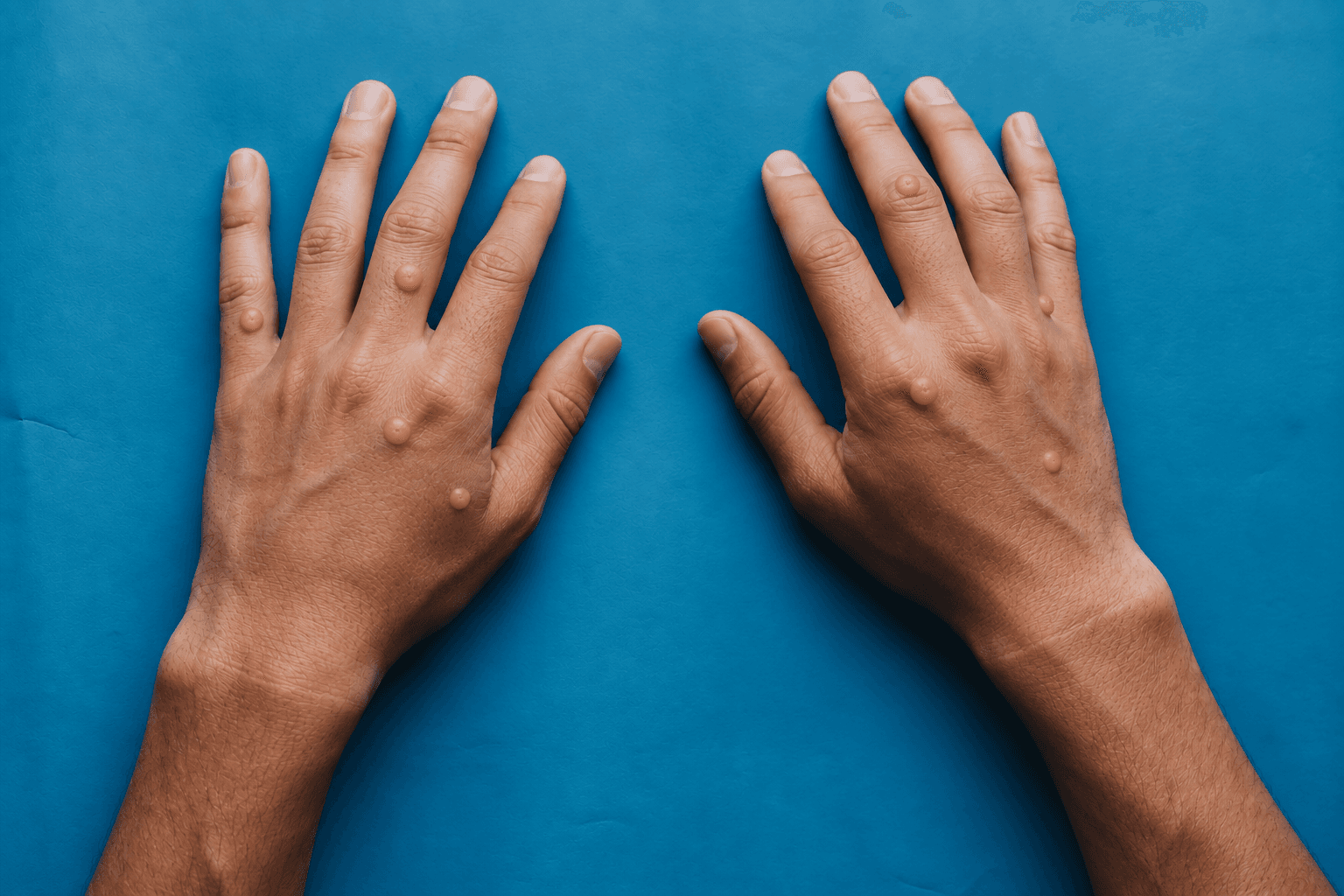
Warts have a reputation for being pretty simple. You notice a rough little bump, assume it's a wart, and move on.
But warts are considerably more interesting than they get credit for.
Some are round and rough. Others are completely flat. Some grow in clusters, some look almost threadlike, and others develop on the bottom of the foot where the pressure of walking can make them surprisingly uncomfortable. There are even warts that grow around the nails and can interfere with normal nail growth.
And despite what childhood folklore may have taught us, frogs have nothing to do with any of it.
So what actually causes warts, why do they look so different, and why does one person seem to get them repeatedly while someone else never does?
It starts with a virus.
So, What Exactly Is a Wart?
A wart is a non-cancerous skin growth caused by certain types of the human papillomavirus, better known as HPV. There are more than 200 types of HPV, and only some of them cause the ordinary skin warts that show up on places like the hands and feet.
The virus can enter the skin through a small break in its surface. And “break” doesn't necessarily mean a cut you can see.
A hangnail can create an opening. So can a scrape. Even shaving creates microscopic breaks in the skin that can provide an opportunity for the virus to enter.
Once HPV infects the skin, it causes cells in that area to grow differently, eventually producing the bump we recognize as a wart.
And eventually is an important word here. A wart doesn't necessarily pop up the day after exposure. It can take weeks or even months before one becomes noticeable.
Which means trying to retrace your steps and figure out exactly where you got one may be a losing game.
Meet the Wart Family
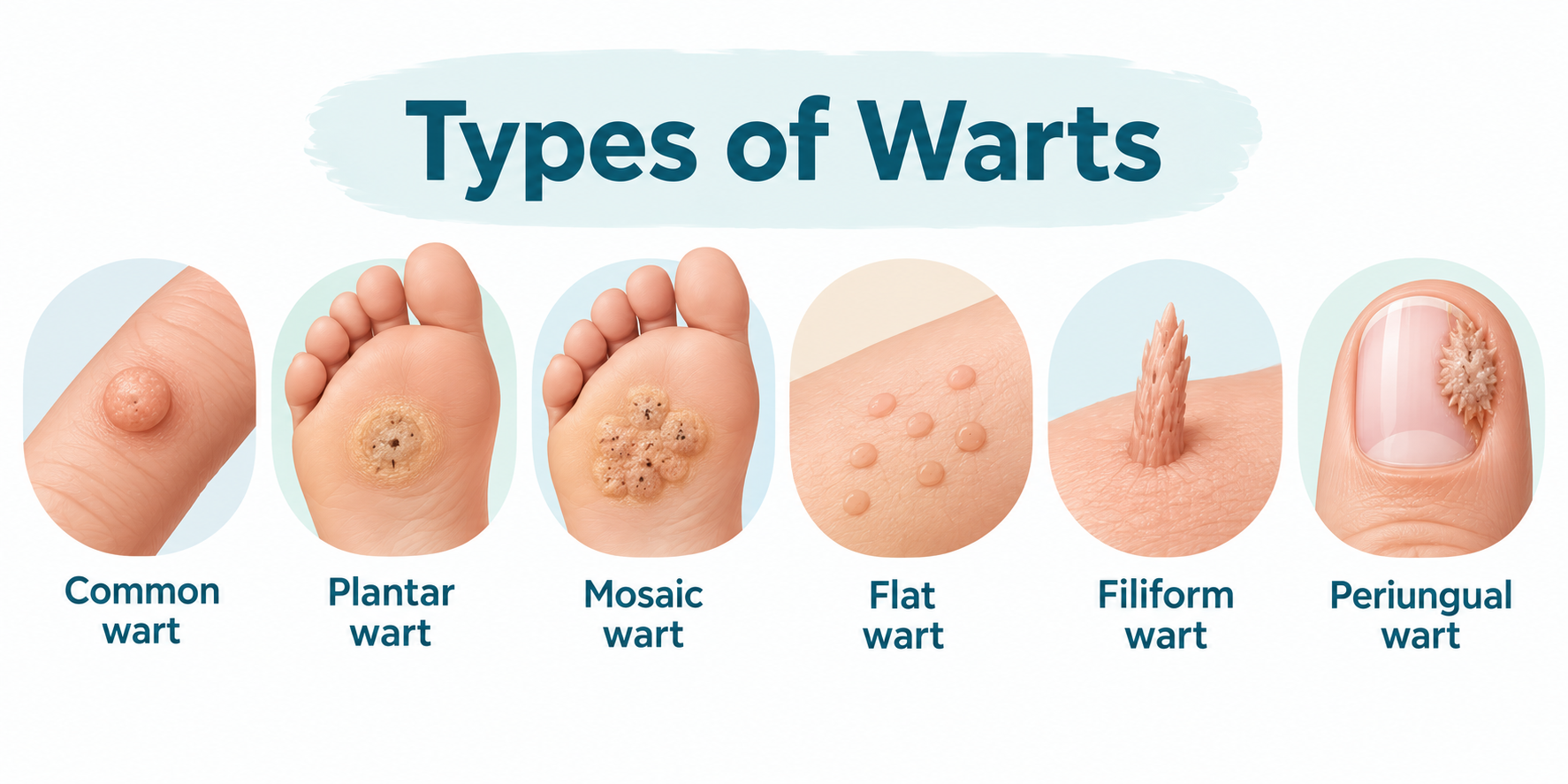
“Wart” is really an umbrella term. The appearance can change quite a bit depending on the type and where it develops.
Common Warts
These are probably closest to what comes to mind when someone says wart.
Common warts, or verruca vulgaris, are usually rough, firm bumps that frequently appear on the fingers, hands, elbows, or knees. They may be round or oval and can contain tiny black dots.
More on those mysterious black dots later.
Common warts often develop in areas where the skin has been injured, including around fingernails where hangnails, biting, or picking can create small openings in the skin.
Plantar Warts
Plantar warts develop on the soles of the feet.
Because you're constantly standing and walking on them, they don't always grow outward like a wart on the hand might. Pressure can push them inward, sometimes beneath a layer of thickened skin. That can make walking uncomfortable, with some people describing the sensation as feeling like there's a pebble under the foot.
They're also sometimes mistaken for corns or calluses, which is one reason location alone doesn't always tell you exactly what a growth is.
Mosaic Warts
Sometimes plantar warts decide not to travel alone.
When multiple warts grow closely together and merge into a larger cluster, they're called mosaic warts. These clusters can spread across a larger area of the foot.
The name makes them sound much prettier than they are.
Flat Warts
Flat warts are the quieter members of the family.
They're generally smaller, smoother, and flatter than common warts, and they often appear in groups. They can develop almost anywhere, but they're particularly common on the face, legs, neck, and other areas where hair is removed.
This is where shaving becomes especially relevant.
Passing a razor over infected skin can create tiny injuries and potentially spread the virus along the area being shaved. That's one reason flat warts may sometimes appear in surprisingly large numbers.
Filiform Warts
If common warts are bumps, filiform warts are more like tiny projections.
They have narrow, threadlike growths that extend away from the skin and tend to occur around the face, particularly near the eyes, nose, or mouth. Unlike flat warts, they generally don't appear in large clusters.
Their unusual appearance can make them easier to notice, but a growth on the face is also a good reason to have a dermatologist confirm what you're actually looking at before attempting to remove it yourself.
Warts Around the Nails
Warts can also develop around the fingernails and toenails. These are known as periungual warts.
Their location makes them particularly annoying. They can involve the skin around the nail and, in some cases, contribute to changes in the nail itself.
Nail biting and picking at the skin around the nails can also create the tiny breaks in the skin that make it easier for HPV to get in.
How Did I Even Get This?
Probably not from a frog.
Warts are contagious because the HPV types that cause them can pass from infected skin to other skin. Transmission can happen through direct contact with a wart or through contaminated surfaces and objects.
Think shared towels, locker room floors, communal showers, or pool areas.
But there's another way warts spread that's easy to overlook:
You can spread them on yourself.
Touching, scratching, picking, or shaving over a wart can move the virus from one area of skin to another, particularly when the second area has a small break in the skin.
So a wart isn't necessarily evidence that you've recently “caught” something from another person. Sometimes the virus has simply found another opportunity on your own skin.
Why Do Some People Seem to Get Warts More Easily?
Exposure to HPV doesn't guarantee that everyone will develop the same number of warts.
Children and younger people commonly develop warts, and certain circumstances can make infection easier. Skin that's frequently damaged, softened by water, shaved, bitten, or picked gives the virus more opportunities to enter. People with weakened immune systems may also have more difficulty clearing wart-causing HPV and can develop numerous or persistent warts.
This also helps explain one of the frustrating things about warts: two people can have very different experiences with them.
One person may develop a single wart that eventually disappears. Someone else may deal with several that seem determined to stay.
Can Warts Go Away on Their Own?
They can.
Many ordinary warts are harmless and may eventually disappear as the immune system responds to the virus. The catch is that eventually can mean months or even years.
That doesn't mean every wart needs to be ignored until it decides to leave.
Location, discomfort, spreading, appearance, and how long it has been present can all influence whether someone seeks treatment. Warts on the bottom of the foot can become painful, while warts on the face or around the nails may create entirely different concerns.
And sometimes the bigger issue isn't the wart itself. It's whether the growth is actually a wart in the first place.
How Can You Keep a Wart From Becoming Five Warts?
There's no perfect way to guarantee that a wart won't spread, but a few habits can reduce opportunities for the virus to move around.
Avoid picking, scratching, or biting at warts. Wash your hands after touching or treating one. Don't shave directly over a wart, since shaving can create microtears and potentially spread the virus to nearby skin. Covering a wart when appropriate can also help reduce direct contact.
In communal showers, locker rooms, and pool areas, footwear provides a barrier between your feet and shared damp surfaces. Avoid sharing personal items such as towels or socks when possible.
And if you use something such as a pumice stone or emery board on a wart, don't turn around and use the same tool on healthy skin. The AAD specifically warns that doing so can spread the wart-causing virus.
In other words, the goal isn't to become afraid of touching your own skin. It's simply to avoid giving the virus an easy ride to its next destination.
Wart Facts That Are Actually Kind of Interesting
Warts have accumulated enough myths and strange characteristics to deserve their own trivia section.
Those black dots aren't wart “seeds.”
You've probably seen the tiny black dots inside some warts. They aren't seeds, roots, eggs, or pieces of the virus.
So no, removing a mysterious “seed” isn't the secret to making a wart disappear.
Frogs and toads have been falsely accused.
The bumps on a toad's skin may look suspicious, but touching a frog or toad does not give you warts. Human warts are caused by HPV, not amphibians.
The frogs are officially cleared of all charges.
You can give yourself another wart.
This sounds strange, but it's one of the more useful facts to know.
Because the virus can move from infected skin to another area, picking at a wart and then touching damaged skin elsewhere can help spread it. Shaving over warts can do something similar.
Flat warts can arrive with friends. Lots of them.
Unlike the classic solitary bump, flat warts frequently occur in groups. The AAD notes that shaving and other forms of hair removal can contribute to their spread, and some people can develop dozens or even hundreds.
A wart can take its time showing up.
Exposure doesn't necessarily lead to an immediate bump. It can take weeks or months before a wart becomes visible.
So that locker room you visited yesterday probably isn't enough evidence to solve the mystery.
Plantar warts have gravity working against them.
Because they grow on weight-bearing areas of the foot, the pressure from standing and walking can push them inward rather than allowing them to project outward. That's part of the reason they can become painful.
When a “Wart” Might Not Actually Be a Wart
This is where the fun facts stop being quite so fun.
Not every rough or raised growth is a wart.
Seborrheic keratoses and some skin cancers can resemble warts. The AAD specifically recommends seeing a dermatologist when you're uncertain about a growth rather than automatically applying an at-home wart treatment.
It's particularly worth getting a growth evaluated if it is changing, bleeding, painful, itching or burning, if you have many warts, or if something you thought was a wart isn't responding as expected. Warts on the face and genital area also warrant professional evaluation rather than experimenting with an at-home remover.
The important point isn't that every unusual bump should be alarming. It's that treating something as a wart works much better when you know it's actually a wart.
How Telederm Can Help
Warts come in enough shapes, sizes, textures, and locations that identifying one isn't always as straightforward as it sounds.
Through Telederm, you can connect with a board-certified dermatologist online from the comfort of home. Your dermatologist can review your photos, symptoms, health history, and previous treatments to better understand your concerns and discuss personalized treatment options when appropriate.
So while you may never know exactly where a wart came from, knowing what you're actually dealing with is a much better place to start. And if nothing else, you can finally stop blaming the frogs.
Telederm Clinical Team, MD | RPh | PharmD | FAAD
Dermatology & Clinical Content Team · Telederm.me
Keep reading.
All in Skin Conditions →
Itchy Feet? Fungus Isn’t the Only Suspect
Fungus may be the first thing that comes to mind when your feet start itching, but it isn’t the only possibility. From eczema and contact dermatitis to bacterial infections, several conditions can leave feet itchy, peeling, or irritated.
Telederm Clinical Team · Sep 22, 2026
Keratosis Pilaris Explained: Why Those Rough Bumps Appear
Tiny rough bumps on the arms, thighs, or cheeks are often caused by keratosis pilaris, a common skin condition sometimes called "chicken skin" or "strawberry skin." Learn what may contribute to these bumps and why they're often mistaken for other skin concerns.
Telederm Clinical Team · Aug 13, 2026
A GLP-1 Can Change More Than the Number on the Scale
Significant weight loss can bring changes beyond the number on the scale. Learn about common skin and hair changes—including hair shedding, dry skin, and changes in facial appearance—and discover simple ways to support healthy-looking skin throughout your weight-loss journey.
Telederm Clinical Team · Aug 4, 2026
Dandruff vs Seborrheic Dermatitis: Key Differences
Dandruff and seborrheic dermatitis can cause similar symptoms, but they aren't exactly the same. Learn the key differences, common causes, and when professional support may help.